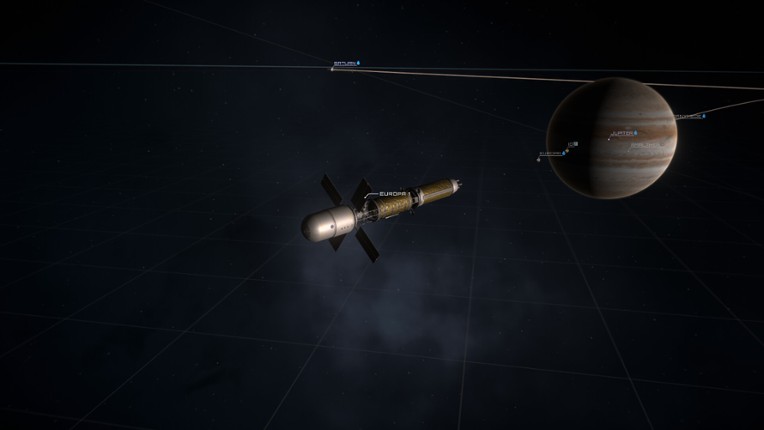
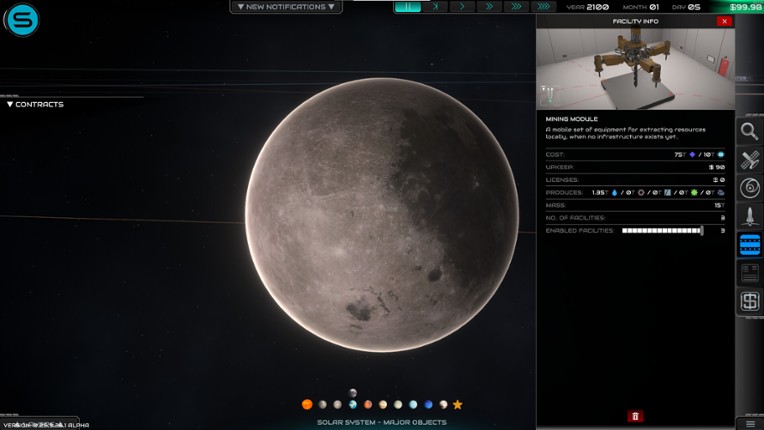
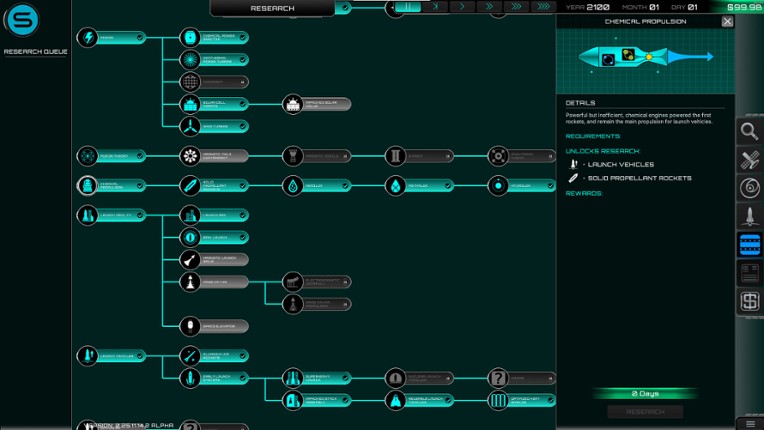
Solar Expanse - Space Exploration Manager Game Cover
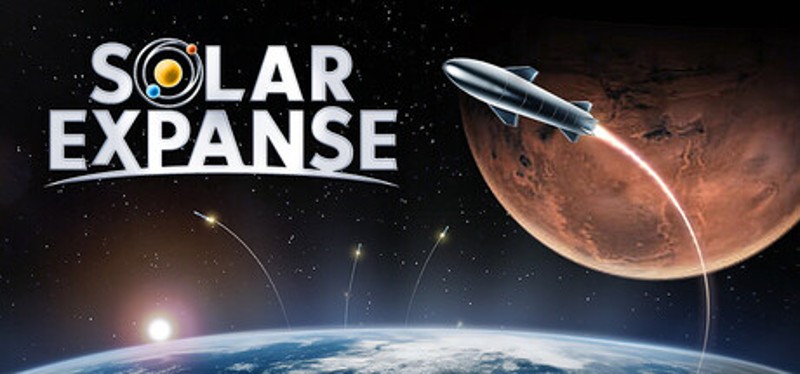
About Solar Expanse - Space Exploration Manager

Solar Expanse - Space Exploration Manager is a single player management game with a science fiction theme. It was developed by SpaceOps and was released on April 9, 2026. It received positive reviews from players.

In Solar Expanse, you take the lead of one of the early XXI century space exploration companies. Your goal will be to reach the planets, moons and asteroids of the system in order to mine and colonize them. Optimize the costs and schedule of the flights. Mind that each object is in constant motion, so exact planning is crucial. Utilize the gravity effects and slingshot your rockets further b…

Skip Games Like Solar Expanse - Space Exploration Manager

Games Like Solar Expanse - Space Exploration Manager

Looking for games like Solar Expanse - Space Exploration Manager? Here are top management recommendations with a science fiction focus, selected from player-similarity data — start with The Crust, Interstellar Transport Company or Dyson Sphere Program.
The Crust Image
Games like The Crust
Interstellar Transport Company Image
Games like Interstellar Transport Company
Dyson Sphere Program Image
Games like Dyson Sphere Program
The Last Starship Image
Games like The Last Starship
Solargene Image
Games like Solargene
Plan B: Terraform Image
Games like Plan B: Terraform
Astro Colony Image
Games like Astro Colony
Cliff Empire Image
Games like Cliff Empire
Per Aspera Image
Games like Per Aspera
Space Haven Image
Games like Space Haven
Skip User Reviews

Reviews

88%Audience ScoreBased on 868 reviews
story29 positive mentions
grinding67 negative mentions

  • Engaging and addictive logistics and space colony management gameplay with a realistic solar system scale and orbital mechanics.
  • Strong foundation and promising concept for space exploration, resource management, terraforming, and long-term progression.
  • Active and responsive development team with frequent updates and a clear roadmap for future content and improvements.
  • User interface and user experience are clunky, unintuitive, and require excessive clicking, leading to micromanagement fatigue.
  • Automation and cyclical missions lack necessary features like resource thresholds, multi-stop routes, and efficient mission planning, causing tedious manual management.
  • Economic balance and AI factions are currently flawed or underdeveloped, with broken trading, weak competition, and unrealistic resource distribution.
  • story

    493 mentions Positive Neutral Negative
    6% positive mentions, 90% neutral mentions, 4% negative mentions

    The game's story is primarily conveyed through mission-based contracts that guide players from moon missions to Mars and beyond, offering a structured yet linear progression. While the early missions and tutorial are well-designed and engaging, users find the overall mission planning system cumbersome, repetitive, and lacking in automation, limiting sandbox freedom and player choice. Many reviewers note that the narrative and mission variety could benefit from more diverse events and deeper mechanics, as well as improved quality-of-life features to reduce tedious micromanagement.

    • “The mission progression is very well thought out and it feels like a natural space progression for humanity.”
    • “It feels very rewarding when a well-planned mission finally reaches its destination.”
    • “The quests really help understanding the game and you learn while playing and using new stuff.”
    • “The game's biggest weakness, at this point, is that you end up needing to transfer resources between gravity wells and far-flung destinations (rare metals, in particular, seem to be exclusive to either asteroids or mercury), and the tool for regular shipments of whatever, cyclical missions, are clumsy and unintuitive, and generally suck unless you're very scaled out and have full-fledged independent launch vehicle production on both ends - this is mostly an issue with gravity wells that your more efficient ships can't escape with cargo aboard.”
    • “You cannot tell a ship to only export resources if there is only a certain amount on the planet, you cannot set a ship to import automatically, you need to dedicate a ship per automated mission you cannot just have a demand for import or export that any available ship in a certain mission group will be able to fill automatically, you cannot set a minimum amount of fuel on the planet before the automated mission leaves meaning any automated mission will fully deplete the fuel stores of a planet making it impossible to leave the planet with any other ship, everything still takes a million clicks to setup yet despite this you cannot save a mission to a folder or duplicate a mission you need to manually retype everything each time.”
    • “The mission planner is pretty barebones: setting up a gravitational slingshot is a tedious process and it isn't apparent until after you put in the clicks whether it's even worth it. Neither can you get any info on how much fuel it takes to bring a ship back when planning a mission. You have to plan a hypothetical mission and note how much is needed for return trip.”
  • gameplay

    169 mentions Positive Neutral Negative
    26% positive mentions, 70% neutral mentions, 4% negative mentions

    The gameplay offers a deep, satisfying core loop centered on space colonization, logistics, realistic orbital mechanics, and terraforming, appealing strongly to fans of strategy and management. However, it features a steep learning curve, UI/automation shortcomings, some unpolished or buggy mechanics, and repetitive micromanagement that can hinder early enjoyment. Despite these issues, the game shows great promise with extensive content, engaging strategic depth, and a steady development roadmap improving features and polish over time.

    • “Peaceful and chill space colonization manager with in-depth logistics and terraforming mechanics.”
    • “The gameplay as it is will give you dozens of hours of fun expanding your infrastructure and taking care of having the resources where and when they are needed, and offers good value for your money even in early access.”
    • “The scale is impressive, and the core gameplay loop of expanding from Earth into the solar system is genuinely satisfying.”
    • “There are quite a few half-implemented mechanics that result in unintuitive results that break immersion, and sent me on a multi-hour quest to figure out what I was doing wrong.”
    • “Most of my issues stem from the high level of micromanagement currently required, which makes the gameplay feel unnecessarily tedious rather than strategic.”
    • “After 20 hours of play, I can say the mechanics are solid and well thought out, but the execution has serious issues that limit the fun for new players.”
  • grinding

    68 mentions Positive Neutral Negative
    1% positive mentions, 0% neutral mentions, 99% negative mentions

    Grinding in the game is widely described as tedious and overly micromanagement-heavy, largely due to cumbersome UI, repetitive resource management, and manual mission setup processes. While some players find the realism and strategic elements rewarding, many express frustration over the lack of quality-of-life improvements and automation, which makes late-game logistics and colony management feel laborious and time-consuming. Overall, polishing and streamlining these mechanics are seen as necessary to reduce the grind and enhance enjoyment.

    • “Basically, there is no working way to automate most tasks, very few tools to easily keep track of what's going on, and even simple tasks are very tedious to do.”
    • “Having to comb over every single planet and asteroid to ensure there are enough supplies, fuel, metals, alloy, glass and such and such is stupidly tedious when there are dozens of them!”
    • “The mission planner is pretty barebones: setting up a gravitational slingshot is a tedious process and it isn't apparent until after you put in the clicks whether it's even worth it.”
  • graphics

    42 mentions Positive Neutral Negative
    52% positive mentions, 41% neutral mentions, 7% negative mentions

    The graphics are generally praised for their beautiful planetary visuals, detailed spacecraft, and realistic space environments, contributing to a strong sense of immersion. However, some users find the interface lacking critical information and note a need for more visual detail in habitats and missions, as well as improvements in orbital visuals and performance optimization. While the game’s aesthetics are solid and run well on modest hardware, it lacks dynamic launch and landing animations that could enhance immersion.

    • “The graphical modeling is beautiful: detailed spacecraft, realistic planet textures.”
    • “✔ Gorgeous planetary visuals and space environments.”
    • “The solar system graphics look great, and you'll see lots of familiar bodies from throughout our solar system that you can go to and colonize.”
    • “The graphics could use a little polishing up, and it would be great if you could pause the rotation of solar bodies as you increase game speed (if you get motion sick, looking at a super spinning planet with even faster spinning moons over and over will get you feeling ill).”
    • “Stuttering: I'm running a fairly good gaming rig, but the fact that stuttering/lag occurs during later-game periods (especially in locations with a lot of active building projects) regardless of graphics settings leads me to believe that there's something in the code itself that isn't handling complex systems at a very optimized level.”
    • “There isn't much graphical representation of what is happening and most of your time is spent clicking through menus to set up production or missions as you expand your organization from Earth into the various resource bearing bodies of the solar system.”
  • optimization

    33 mentions Positive Neutral Negative
    36% positive mentions, 49% neutral mentions, 15% negative mentions

    Optimization in the game is generally good on mid to high-end systems, running smoothly with stable performance and impressive graphics; however, late-game lag and stuttering occur during large-scale building or mass mission launches, indicating code inefficiencies in handling complex systems. Additionally, the UI needs refinement to reduce repetitive and click-intensive tasks, and certain mechanics, such as hauling missions, can strain performance. As an early access title, improvements in bug fixes, UI usability, and late-game optimization are expected to enhance the experience further.

    • “Solar Expanse is a good-looking game that runs smoothly.”
    • “Optimization was stellar with the game running at full speed even when pretty far into the game's life.”
    • “This game is great even though it's still in early access. If you want a space colonization game that runs smoothly I suggest this game 100%.”
    • “Stuttering: I'm running a fairly good gaming rig, but the fact that stuttering/lag occurs during later-game periods (especially in locations with a lot of active building projects) regardless of graphics settings leads me to believe that there's something in the code itself that isn't handling complex systems at a very optimized level.”
    • “Performance is not great and degrades over time, which is tough in a game with essentially no graphics and only like maybe 20-30 spacecrafts flying around.”
    • “(b) There needs to be a better way to perform haul cycle missions since having 80%+ just haul ships uses up a large amount of processing resources and feels inefficient, apparently affecting performance (repeated lags every few seconds) on AMD 9950X3D, 128GB RAM with NVIDIA 4090, which is a fairly high-end PC at the moment.”
  • atmosphere

    30 mentions Positive Neutral Negative
    27% positive mentions, 63% neutral mentions, 10% negative mentions

    Users appreciate the game's detailed and dynamic atmosphere modeling, including realistic factors like atmospheric composition, pressure, magnetic fields, and resource management crucial for terraforming. While some desire more cinematic moments and clearer guidance on terraforming targets, the simulation of planetary atmospheres and their impact on habitability is praised for depth and immersion.

    • “Atmosphere composition and pressure, resource availability, temperature, radiation, and orbit are all modeled on a per-body basis.”
    • “Longer term, you will be terraforming the Martian environment, building huge magnetospheres to protect the surface from the harsh radiation, and sucking gases from Jupiter and Venus to add atmospheric pressure to the red planet which then stabilizes the initially large temperature swings.”
    • “Atmospheric pressure, oxygen level, temperature, radiation level, gravity, and water level all matter for the habitability of the planet.”
    • “No short cinematic, no atmosphere, no 'welcome to space!' moment.”
    • “Other buildings like solar panels will tell you their base output but not their actual output factoring in solar distance and atmosphere until they're completely built, which can severely hamper early Mars base planning as you don't know how many you need to build to support your infrastructure.”
    • “Some guidance on terraforming wouldn't hurt, I get the gist of it, but some numbers to hit like: (add x more nitrogen and y more CO2 to the atmosphere) would be nice to figure out if the means I'm using are going to get me there in 50 years or 400.”
  • stability

    29 mentions Positive Neutral Negative
    17% positive mentions, 0% neutral mentions, 83% negative mentions

    The game runs generally well without crashes, but is currently plagued by numerous bugs, especially in the UI and mission mechanics, causing freezes, glitches, and occasional game-breaking issues. Despite these stability problems being typical for an early access/pre-alpha title, the gameplay remains enjoyable and the developers appear actively engaged in fixing them.

    • “Fun to play, runs great.”
    • “Runs great on Linux!”
    • “Otherwise the game runs great, sounds good and has an interesting play style that city builders and explorers alike can enjoy.”
    • “Of course, there is a lot of irritating stuff that needs to be fixed, from buggy supply missions to small respawning asteroids that have almost nothing on them (and they are limited, a terrible mistake, I know it is because of performance). Then the constant need to manually deorbit them, also many click-intensive menus. Editing orders deletes them, very hard to view the cyclic mission list. Interstellar ships get deleted after leaving, nobody hears about them ever again, empty space behind Jupiter with no objects, and so on.”
    • “The UI can be a bit clunky; repeating missions for your ships or catapults/magnetic launchers can be buggy and not work.”
    • “Currently buggy as hell when it comes to getting cyclical missions to work (they just don't work sometimes).”
  • music

    23 mentions Positive Neutral Negative
    26% positive mentions, 61% neutral mentions, 13% negative mentions

    The music in the game is generally repetitive, limited to one or two tracks, which leads to annoyance and a desire for a larger, more varied soundtrack. While some appreciate the core ambient or epic style, many feel it doesn't fit the game's tone and becomes grating over time. Additionally, copyrighted music poses challenges for content creators wishing to stream gameplay.

    • “The ambient music is to lose oneself to.”
    • “Last note, I love the music.”
    • “I would like to see more music added, as amazing as the one song that plays is.”
    • “For any content creator that wants to stream this game, avoid using the music, all!”
    • “The music is way over the top and repeats its few tracks too often, making it quite annoying.”
    • “The music and presentation don’t match the tone of the experience, which is a shame because first impressions matter a lot.”
  • replayability

    10 mentions Positive Neutral Negative
    30% positive mentions, 40% neutral mentions, 30% negative mentions

    Replayability is currently limited by core design choices and some clunky mechanics, but planned features like new solar systems, mod support, and multiple factions/tech paths offer promising potential. Players appreciate the game's depth in space exploration and logistics management, with challenges encouraging repeated runs to improve. Improvements such as a more flexible tech system and random solar system generation could significantly enhance replay value.

    • “Replayability will come from new solar systems, which are already planned, and mods, which some are already there and are great and fix some issues.”
    • “It's kept me engaged for about a hundred hours at this point and I feel there is still replayability for some factions and tech focus/tactics I haven't tried yet.”
    • “Replay value is also pretty big because you will make mistakes and will want to remediate them in the next run (only to make other mistakes).”
    • “There are some core design choices that will limit replayability and depth.”
    • “Lack a bit of replayability and multiplayer at the moment.”
    • “A more flexible system, like a tech tree where you choose goals, would improve player agency and replayability.”
  • humor

    8 mentions Positive Neutral Negative
    100% positive mentions, 0% neutral mentions, 0% negative mentions

    The humor in the game often arises from its amusing scientific inaccuracies and gameplay quirks, such as the absence of the Kuiper Belt and the AI's excessive payments for resources. Players find the balance issues and certain game mechanics unintentionally funny, adding a lighthearted charm to the experience. Overall, the humor is subtle and stems mainly from the game's oddities and unexpected moments.

    • “It's also funny that there can be fusion-capable interplanetary civilizations in the game that are unable to construct domed cities on Mars.”
    • “There was this funny moment in the game where I flew an Atlas over to an asteroid China had heavily colonized and moved it on a collision course with Mars for its resources.”
    • “Overall after 25 hours I feel it's heading in a positive direction, though I will say it's quite funny having the AI pay you millions upon millions of dollars for some electronics or rare metals on Mars (though probably unintentional).”
  • emotional

    2 mentions Positive Neutral Negative
    100% positive mentions, 0% neutral mentions, 0% negative mentions

    The game is generally described as lacking emotional impact, with a UI that feels bland and uninspiring. Some users express reservations about the use of AI-generated images, though they acknowledge practical constraints faced by the developers.

Skip Game Offers

Buy Solar Expanse - Space Exploration Manager

Play Times

40h Median play time
66h Average play time
17-86h Spent by most gamers
*Based on 11 analyzed playthroughs
Skip Videos

Videos

Skip FAQs

Frequently Asked Questions

Solar Expanse - Space Exploration Manager is a management game with science fiction theme. Common tags for Solar Expanse - Space Exploration Manager include indie, educational, exploration, early access, building and others.

Solar Expanse - Space Exploration Manager is available on PC and Windows.

On average players spend around 66 hours playing Solar Expanse - Space Exploration Manager.

Solar Expanse - Space Exploration Manager was released on April 9, 2026.

Solar Expanse - Space Exploration Manager was developed by SpaceOps.

Solar Expanse - Space Exploration Manager has received positive reviews from players. Most players liked Solar Expanse - Space Exploration Manager for its story but disliked it for its grinding.

Solar Expanse - Space Exploration Manager is a single player game.

Similar games include The Crust, Interstellar Transport Company, Dyson Sphere Program, The Last Starship, Solargene and others.