- July 27, 2017
- Ripknot Systems
Professor Watts: Memory Match


Platforms


 Buy Now
About Professor Watts: Memory Match

Professor Watts: Memory Match is a single player casual puzzle game. It was developed by Ripknot Systems and was released on July 27, 2017. It received neutral reviews from players.
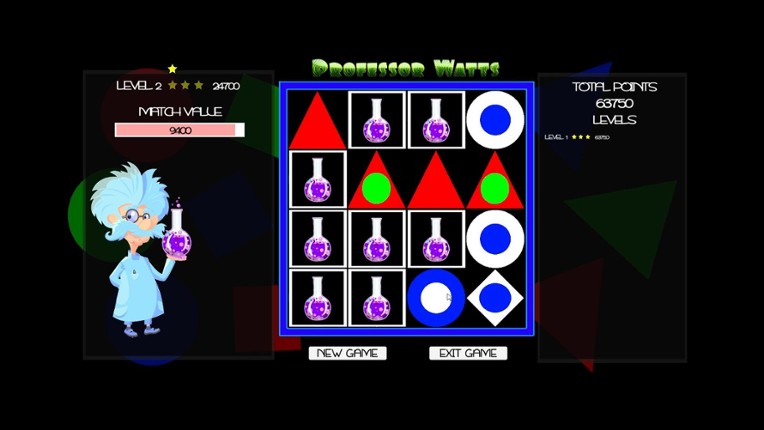
Hello Professor Watts here and I have some research to do on memory skills. I have assembled a wide variety of shapes and colors to put our memory to the test. We can see how we're doing by completing matches in a specific amount of time and earning points to track our overall progress. Complete 80 challenging randomized memory match puzzles and aim for a new top score each time you play.

Games Like Professor Watts: Memory Match
Looking for games like Professor Watts: Memory Match? Here are top casual puzzle recommendations, selected from player-similarity data — start with Professor Watts Word Search: Into The Ocean, Trivia Vault Hockey Trivia or Trivia Vault: Technology Trivia Deluxe.







Reviews
- Professor Watts Memory Match offers a straightforward and accessible puzzle experience, making it ideal for casual players and children looking to improve their memory skills.
- The game features a clean and minimalist design with vibrant colors, ensuring clarity and ease of play, which is beneficial for younger audiences or those new to gaming.
- It runs smoothly on low-end hardware, allowing virtually anyone to enjoy the game without technical issues, and its quick sessions make it suitable for brief mental exercises.
- The game suffers from a lack of depth and variety, leading to repetitive gameplay that can quickly become unengaging after a few sessions.
- Many players criticize the excessive achievement spam, with thousands of achievements that feel meaningless and serve primarily to inflate player profiles rather than enhance the gaming experience.
- Overall, the game is viewed as a low-effort, copy-paste title that lacks creativity and polish, making it hard to justify its price, especially when it offers little more than a basic memory matching mechanic.
gameplay
12 mentions Positive Neutral NegativeThe gameplay of Professor Watts' Memory Match is centered around a simple and accessible card-matching mechanic that emphasizes cognitive training, making it easy to understand and satisfying for casual players. However, the lack of variation in objectives and mechanics can lead to a repetitive experience, and some users feel it lacks depth, reducing it to a tool for achievement collection rather than engaging gameplay. Overall, while it serves well for educational purposes, its simplicity may not appeal to those seeking more complex or varied gameplay experiences.
“It belongs to the casual, cognitive-training niche of games that prioritize accessibility and mental exercise over complex mechanics or storytelling.”
“The core mechanic is instantly familiar—flip cards, remember their positions, and find matching pairs—but the addition of time limits gives it a sense of urgency.”
“While the gameplay never strays far from this basic loop, it’s the sort of mechanic that’s easy to grasp and naturally satisfying.”
“From a gameplay standpoint, the simplicity of Professor Watts' Memory Match can be both its greatest strength and its primary weakness.”
“The lack of variation in objectives or mechanics means that the experience can start to feel repetitive after a handful of sessions.”
“A randomly generated grid of cards with no difficulty curve or difference in gameplay.”


Buy Professor Watts: Memory Match


Videos

Frequently Asked Questions
Professor Watts: Memory Match is a casual puzzle game. Common tags for Professor Watts: Memory Match include indie, 2d, choices matter, family friendly and relaxing.
Professor Watts: Memory Match is available on PC and Windows.
Professor Watts: Memory Match was released on July 27, 2017.
Professor Watts: Memory Match was developed by Ripknot Systems.
Professor Watts: Memory Match has received neutral reviews from players. Most players liked Professor Watts: Memory Match for its graphics but disliked it for its gameplay.
Professor Watts: Memory Match is a single player game.
Similar games include Professor Watts Word Search: Into The Ocean, Trivia Vault Hockey Trivia, Trivia Vault: Technology Trivia Deluxe, Trivia Vault Mini Mixed Trivia 3, Trivia Vault: Mini Mixed Trivia 4 and others.